From Local Voices to the Global Process: The Ulaanbaatar Declaration Enters the Formal COP17 Process
From the Mayors’ Forum to the formal COP17 process
Held from 20 to 22 August in Ulaanbaatar, Mongolia, the UNCCD COP17 Mayors’ Forum was hosted by the Governor's Office of the Capital City of Ulaanbaatar and co-organized by the UNCCD Secretariat, UN-Habitat and ICLEI – Local Governments for Sustainability, with Local2030 Coalition and United Cities and Local Governments (UCLG), through the Global Taskforce of Local and Regional Governments (GTF) as key partners.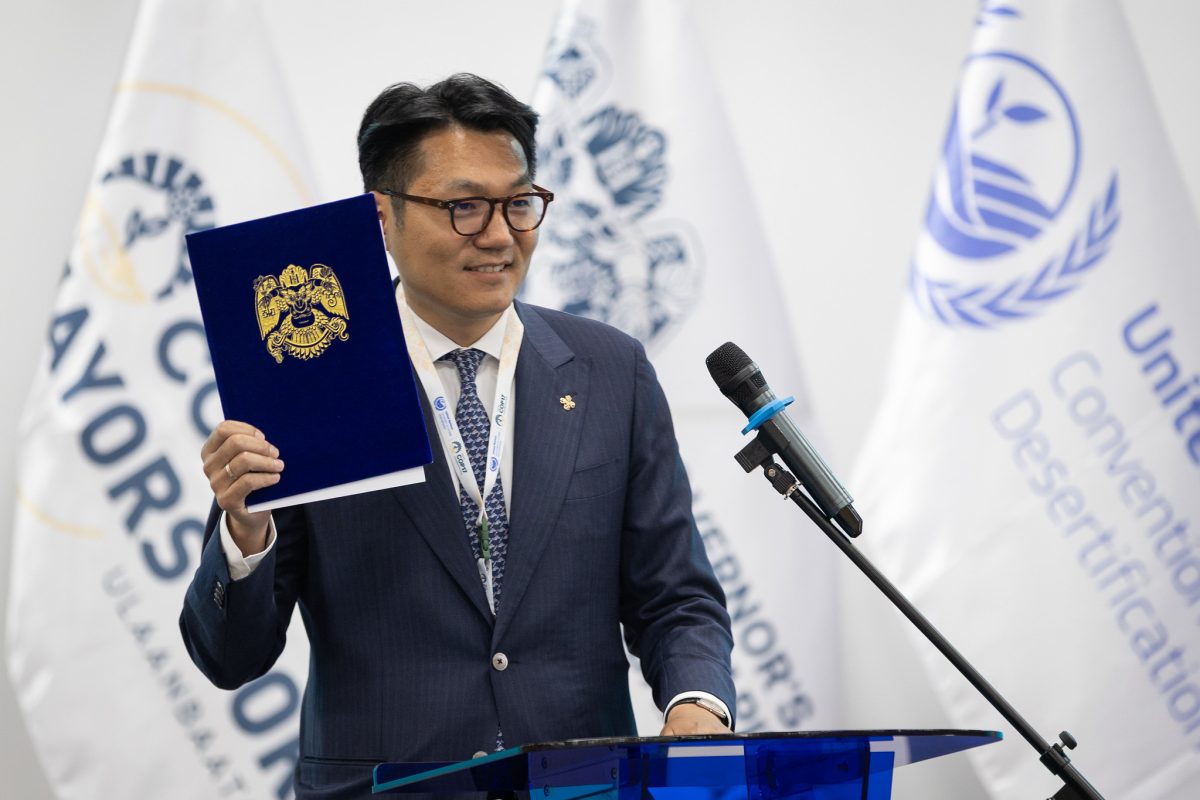
Purevdagva Byaruuzana, Governor of Capital City and Mayor of Ulaanbaatar, announced the Ulaanbaatar Declaration at the Forum (Photo: © UNCCD/Kiara Worth)
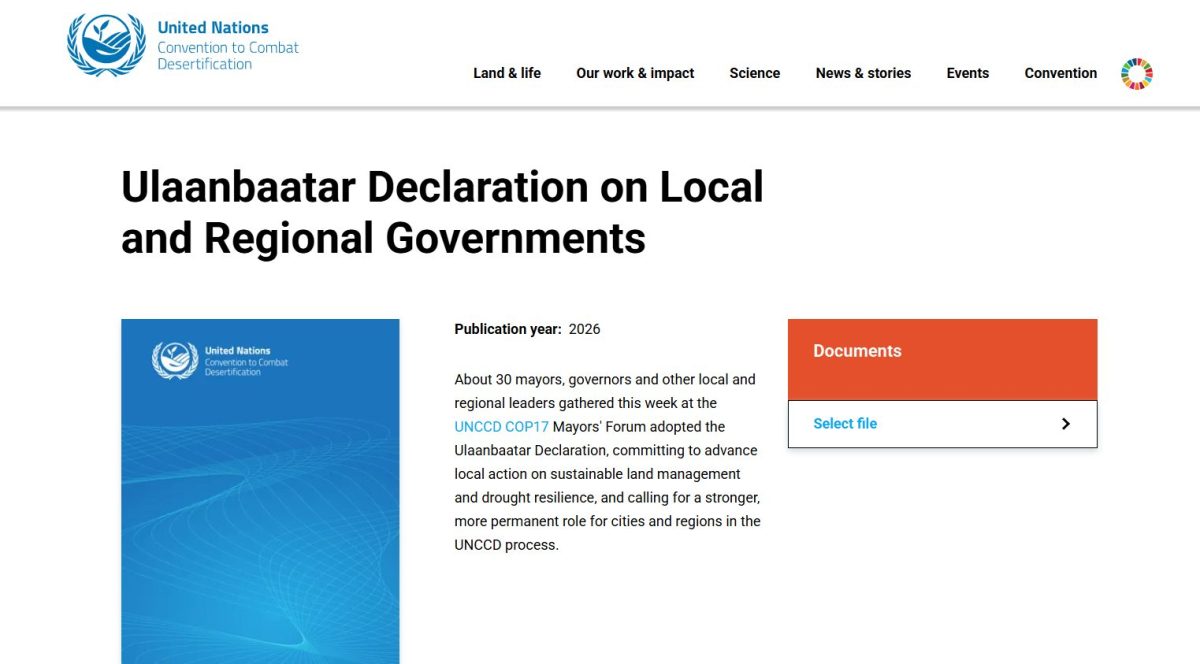
The Forum brought together more than 200 participants from over 30 countries, including around 30 mayors, governors and other local and regional government leaders, and concluded with the adoption of the Ulaanbaatar Declaration on Local and Regional Governments.[3][6] The Declaration underscores that global goals on land and drought resilience ultimately need to be translated into action in cities, regions and communities. Local and regional governments are not only essential implementers of global commitments, but should also be more systematically and continuously engaged in related policy-making, financing, implementation and monitoring processes. Following the Forum, this collective position continued its journey into the formal COP17 process. On 25 August, Governor and Mayor Purevdagva presented the Ulaanbaatar Declaration during the Open Dialogue Session, emphasizing the importance of multilevel governance in implementing the Convention and bringing the outcomes of the Mayors’ Forum into the formal discussions of the COP17.[1][2]From the Ulaanbaatar Declaration to a formal COP17 outcome
On 26 August, a draft decision on the Declaration of the Mayors’ Forum, submitted by the President of COP17, was issued as official UN document ICCD/COP(17)/L.4.[4]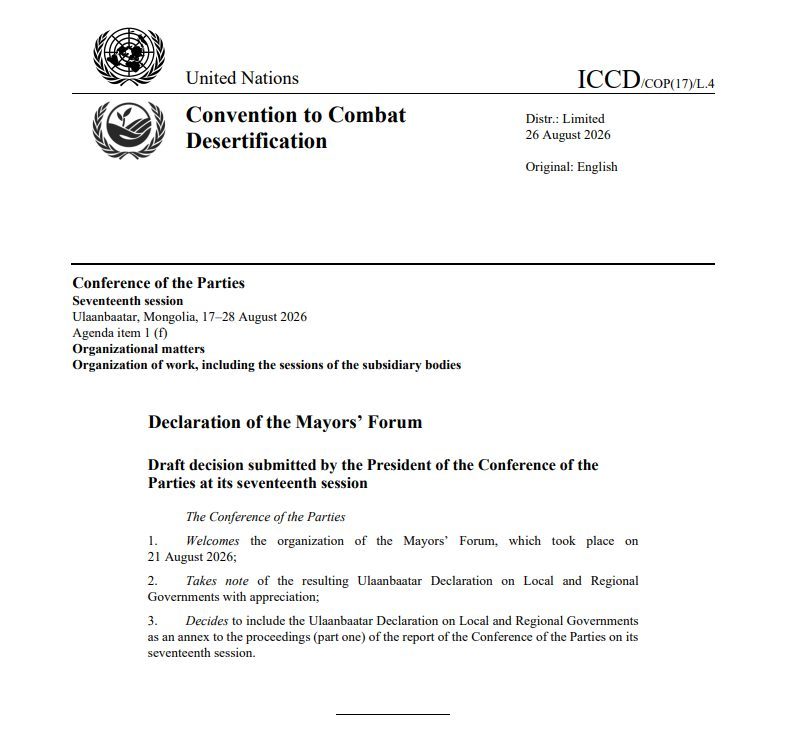
- welcomes the organization of the Mayors’ Forum on 21 August 2026;
- takes notes with appreciation of the resulting Ulaanbaatar Declaration on Local and Regional Governments; and
- decides to include the Declaration as an annex to the proceedings of the report of COP17 (Part One).[4]
From global commitments to local action
As one of the co-organizers of the COP17 Mayors’ Forum, ICLEI continues to advance the engagement of local and regional governments in the global land agenda, while strengthening synergies between land governance, climate action, biodiversity, water and sustainable urban development. The significance of this process goes beyond the development of a declaration by local governments. It demonstrates how the experiences and collective priorities of local and regional governments can be brought more systematically into formal global intergovernmental processes. In 2026, all three Rio Convention COPs are taking place in succession. Following UNCCD COP17, CBD COP17 and UNFCCC COP31 will provide further opportunities to advance synergies across the land, biodiversity and climate agendas through implementation at the local and regional levels. From Ulaanbaatar, the message of the Ulaanbaatar Declaration is clear: Global commitments must reach cities, regions and communities if they are to be translated into tangible action on the ground. ICLEI will continue working with local and regional governments, UN agencies, national governments and partners to bring local voices and practices more systematically into global processes, while supporting cities and regions in translating global goals into concrete local action. ____________ References: [1] IISD Earth Negotiations Bulletin|UNCCD COP17 Daily Report, 25 August 2026 [2] UN-Habitat|Mayors’ Forum strengthens role of cities in land resilience at COP17 in Mongolia [3] UNCCD|Ulaanbaatar Declaration on Local and Regional Governments [4] UNCCD|ICCD/COP(17)/L.4 — Declaration of the Mayors’ Forum [5] IISD Earth Negotiations Bulletin|UNCCD COP17 Final Summary [6] COP 17 Mayors' Forum | UNCCD Author / Ge LIU Editor / Xiaoqian ZHOU
The Governor and Mayor of Ulaanbaatar presented the outcomes of the COP17 Mayors’ Forum on behalf of local and regional governments, bringing the Ulaanbaatar Declaration into the formal intergovernmental process of UNCCD COP17 and its official proceedings.
On 25 August 2026, during the high-level segment of the 17th session of the Conference of the Parties to the United Nations Convention to Combat Desertification (UNCCD COP17), B. Purevdagva, Governor and Mayor of Ulaanbaatar, presented the outcomes of the COP17 Mayors’ Forum and the Ulaanbaatar Declaration on Local and Regional Governments during the Open Dialogue Session, on behalf of the local and regional government leaders participating in the Forum. He highlighted the importance of multilevel governance and the critical role of local and regional governments in implementing the Convention.[1][2]
This marked an important step in bringing the collective voice of local and regional government leaders gathered in Ulaanbaatar into the formal intergovernmental process of UNCCD COP17.
From the Mayors’ Forum to the formal COP17 process
Held from 20 to 22 August in Ulaanbaatar, Mongolia, the UNCCD COP17 Mayors’ Forum was hosted by the Governor’s Office of the Capital City of Ulaanbaatar and co-organized by the UNCCD Secretariat, UN-Habitat and ICLEI – Local Governments for Sustainability, with Local2030 Coalition and United Cities and Local Governments (UCLG), through the Global Taskforce of Local and Regional Governments (GTF) as key partners.
Purevdagva Byaruuzana, Governor of Capital City and Mayor of Ulaanbaatar, announced the Ulaanbaatar Declaration at the Forum (Photo: © UNCCD/Kiara Worth)
The Forum brought together more than 200 participants from over 30 countries, including around 30 mayors, governors and other local and regional government leaders, and concluded with the adoption of the Ulaanbaatar Declaration on Local and Regional Governments.[3][6]
The Declaration underscores that global goals on land and drought resilience ultimately need to be translated into action in cities, regions and communities. Local and regional governments are not only essential implementers of global commitments, but should also be more systematically and continuously engaged in related policy-making, financing, implementation and monitoring processes. Following the Forum, this collective position continued its journey into the formal COP17 process.
On 25 August, Governor and Mayor Purevdagva presented the Ulaanbaatar Declaration during the Open Dialogue Session, emphasizing the importance of multilevel governance in implementing the Convention and bringing the outcomes of the Mayors’ Forum into the formal discussions of the COP17.[1][2]
From the Ulaanbaatar Declaration to a formal COP17 outcome
On 26 August, a draft decision on the Declaration of the Mayors’ Forum, submitted by the President of COP17, was issued as official UN document ICCD/COP(17)/L.4.[4]
The document:
- welcomes the organization of the Mayors’ Forum on 21 August 2026;
- takes notes with appreciation of the resulting Ulaanbaatar Declaration on Local and Regional Governments; and
- decides to include the Declaration as an annex to the proceedings of the report of COP17 (Part One).[4]
On 28 August, at the closing plenary of COP17, Parties formally adopted the Declaration of the Mayors’ Forum (ICCD/COP(17)/L.4). The final report of the IISD Earth Negotiations Bulletin records its adoption alongside the declarations of the Youth Forum, Indigenous Peoples and Local Communities.[5]
This completed an important journey: from developing a collective position at the Mayors’ Forum, to its presentation to COP17 by the Governor and Mayor of Ulaanbaatar on behalf of local and regional governments, and finally to the issuance and formal adoption of L.4 by the COP17 closing plenary. Through this process, the voices of local and regional governments reflected in the Ulaanbaatar Declaration were further embedded in the formal intergovernmental record of UNCCD COP17.
From global commitments to local action
As one of the co-organizers of the COP17 Mayors’ Forum, ICLEI continues to advance the engagement of local and regional governments in the global land agenda, while strengthening synergies between land governance, climate action, biodiversity, water and sustainable urban development.
The significance of this process goes beyond the development of a declaration by local governments. It demonstrates how the experiences and collective priorities of local and regional governments can be brought more systematically into formal global intergovernmental processes.
In 2026, all three Rio Convention COPs are taking place in succession. Following UNCCD COP17, CBD COP17 and UNFCCC COP31 will provide further opportunities to advance synergies across the land, biodiversity and climate agendas through implementation at the local and regional levels.
From Ulaanbaatar, the message of the Ulaanbaatar Declaration is clear:
Global commitments must reach cities, regions and communities if they are to be translated into tangible action on the ground.
ICLEI will continue working with local and regional governments, UN agencies, national governments and partners to bring local voices and practices more systematically into global processes, while supporting cities and regions in translating global goals into concrete local action.
____________
References:
[1] IISD Earth Negotiations Bulletin|UNCCD COP17 Daily Report, 25 August 2026
[2] UN-Habitat|Mayors’ Forum strengthens role of cities in land resilience at COP17 in Mongolia
[3] UNCCD|Ulaanbaatar Declaration on Local and Regional Governments
[4] UNCCD|ICCD/COP(17)/L.4 — Declaration of the Mayors’ Forum
[5] IISD Earth Negotiations Bulletin|UNCCD COP17 Final Summary
[6] COP 17 Mayors’ Forum | UNCCD
Author / Ge LIU
Editor / Xiaoqian ZHOU